
The debate on balancing prudence with citizen needs amid economic flux, meanwhile Singapore’s budget might see surprising surpluses, would that mean more goodies in Budget 2024?
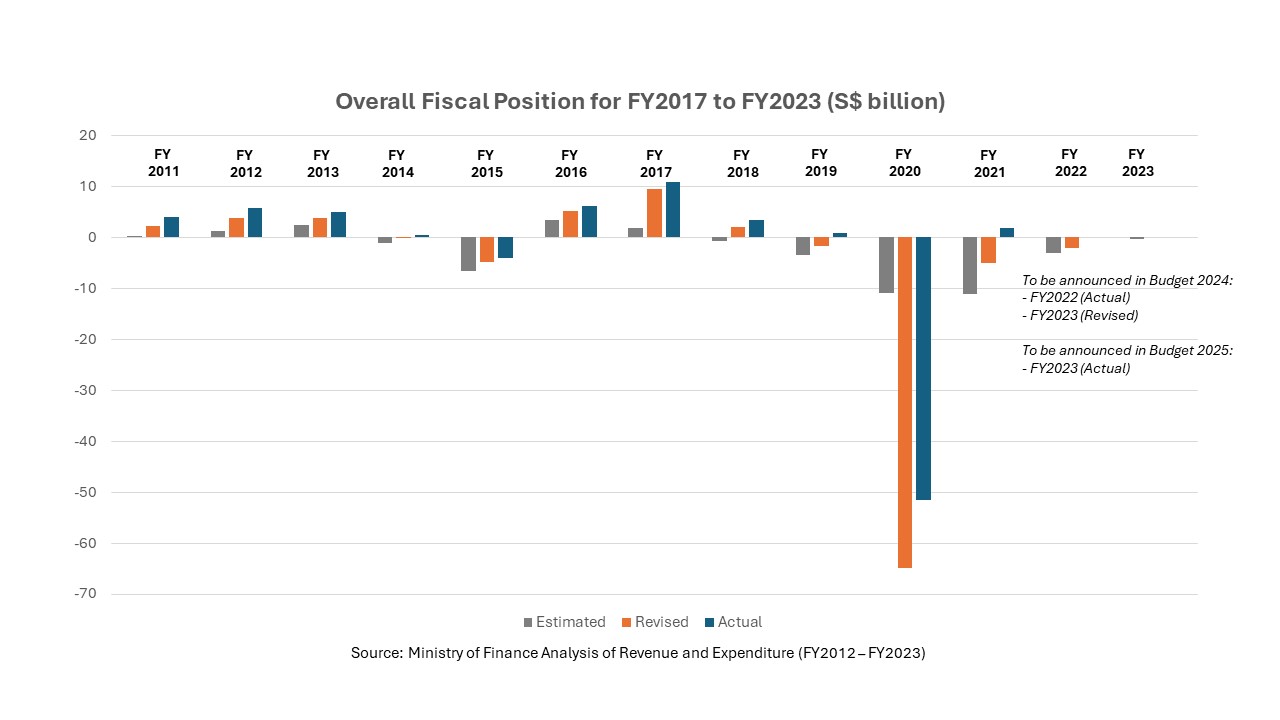
The announcement of Budget 2023 grabbed headlines, but it has not gone unnoticed that the Singapore Budget has followed a general trend: the budget deficits are usually not as large as estimated, while surpluses are usually bigger than expected. This trend is evident over the past decade except for the tumultuous year of FY2020, when Covid-19 first hit Singapore.

In that year, the estimated deficit was S$10.95 billion while the revised deficit turned out to be a whopping S$64.9 billion. That initial estimate was made when the Budget was delivered in February 2020, before the full economic impact of the pandemic was clear. Other than that year, every other year has seen a prudent estimation of the budget surplus/deficit, with FY2018 even seeing an estimated deficit of S$600 million turn into a revised surplus of S$2.12 billion.
While unforeseen events like the Covid-19 upheaval occasionally throw plans off course, Deputy Prime Minister and Finance Minister Lawrence Wong defends this approach as “prudent,” emphasizing a judicious use of national reserves, Singapore’s financial planning typically showcases prudent estimations.
However, this has sparked debate about the government’s cautious approach and striking a balance between conservatism and meeting citizens’ needs. For instance, can the Government continue justifying tax increases when the Budget shows a higher-than-expected surplus or lower-than-expected deficit for most years?
First let’s understand the budget process.
About the Budget
The annual Budget is the government’s plan for how it will get money and spend it in the upcoming fiscal year and is prepared on a financial year (FY) basis. The FY for the Government runs from 1 April of one year to 31 March of the following year. For example, FY2018 is from 1 April 2018 to 31 March 2019.
The Budget serves two purposes:
a. It serves as a record of the approved levels of expenditure and accountability in the usage of government funds; and
b. It is also a plan of the estimated government revenue and expenditures for the FY.
The process:
Before drawing up the Budget, MOF starts its public consultation process in November to gather feedback for the next financial year’s Budget. The feedback process generally lasts for about two months, and all views and suggestions submitted during the feedback period are taken into account in the design of the Budget. After which, the Budget is presented to the Cabinet for approval.
After Parliament passes the Supply Bill through a vote, thus giving its approval of the budget, the President then needs to give his assent to the bill before it can come into effect. The President’s role is to safeguard the past reserves of the nation, and he may withhold his assent to the Bill if, in his opinion, the estimated revenue and expenditure are likely to draw on Past Reserves.
Once the President gives his assent to the Supply Bill, it is then enacted as law as the Supply Act. The Act will then control the amount of money that the Government may spend in the coming FY, and for what purposes this money may be spent on.
Watch a video on how the Budget is approved in Parliament here:
Where does the Government Operating Revenue come from?
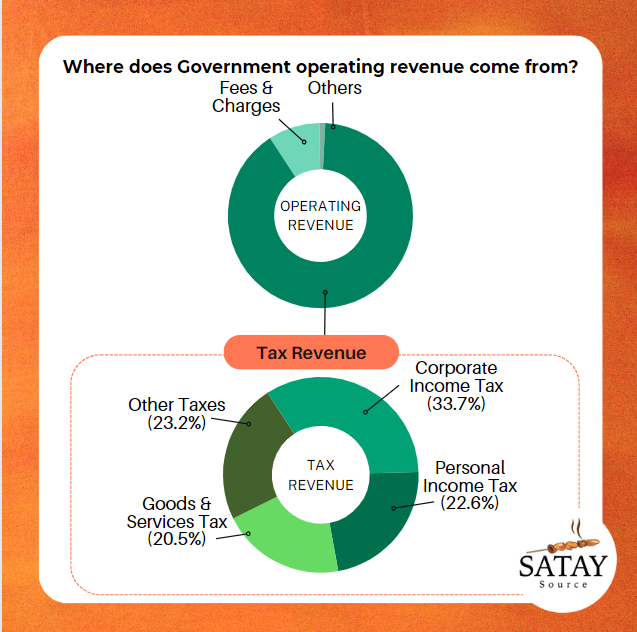
Government operating revenue is about 15% of Singapore’s gross domestic product (GDP), with the bulk coming from Tax revenue (Corporate Income Tax, Personal Income Tax and the Good and Services Tax) which accounts for over 90% of this. The other main sources of operating revenue are fees and charges, as well as other receipts – that is, investment and interest income.
In recent years, about one-third of tax revenue has tended to come from corporate income tax; over one-fifth comes from personal income tax, and about another fifth comes from goods and services tax. Other taxes include stamp duty, property tax and betting taxes.
What does the Government spend the budget on?
Expenditure is also distributed appropriately across all sectors, be it in the social development, economic development, security and external relations, or government administration sector. The largest share of the government’s expenditure budget goes to the social development sector (Health, public housing, education and national development). The second largest sector is security and external relations, followed by economic development, and then government administration.

Singapore is required under the Constitution to keep a balanced budget over each term of Government
The spending plan shows the government’s priorities and who will receive public funds. Each year’s Budget may run a surplus or deficit, but under the Constitution, the government is required to keep a balanced budget over each term of government. This means that the government should not spend more than it earns during each term of office. However, the government’s fiscal management philosophy goes beyond merely achieving a balanced budget. In practice, the government aims to accumulate a net budget surplus, which provides reserves for future needs and economic uncertainties.

What is a balanced budget all about?
Singapore’s fiscal policies have helped to steward the country’s progress over the years. These policies are designed to foster macroeconomic stability, support economic growth, and promote social equity. This is achieved by maintaining a balanced budget, investing for the future, and ensuring a fair and progressive fiscal system, so that there will be sufficient resources to meet society’s needs. In essence, expenditures never exceed Singapore’s earnings or receipts.
Not only is the budget balanced in fiscal terms, but it seeks a good distribution of budget provisions for the many demands in economic development, social development, defence and security, and government administration. Such as focusing on public goods and infrastructure that enable citizens and businesses to thrive and grow. The government also invests heavily in skills, education and infrastructure to develop the nation and lay the foundations for long-term economic growth. A steady amount of spending is also committed to security and defence to safeguard Singaporeans’ way of life.
Moreover, as the society matures and ages, an increasing proportion of public spending has been channeled towards social developmentOver the last decade, Singapore has almost doubled social spending from S$20 billion in FY2010, to S$37 billion in FY2019. Today, social spending makes up the largest part of annual government expenditure. A large part of the increase has gone towards improving the quality, accessibility and affordability of healthcare, for which spending has tripled over the last decade.
Associate Professor Eugene Tan, a law lecturer at the Singapore Management University, said that successive governments under all three of the nation’s prime ministers have been and are prudent in managing the national budgets.
This is not necessarily a bad thing.
“This means that the Government has been prudent and disciplined in the use of fiscal resources, manifested in balanced budgets and surpluses in most years,” – Associate Professor Eugene Tan, a law lecturer at the Singapore Management University
Going forward, economic growth is expected to fluctuate more. To allow the economy to remain nimble and competitive, the government-of-the-day has to adhere to prudent financial management, seeking to accumulate a modest budget surplus whenever feasible, and setting aside reserves during favorable years to mitigate against times of crises. This reserve serves as a cushion, allowing the government to run deficits during periods of global economic restructuring, national security threats, and other challenges, while safeguarding Singapore’s long-term financial stability.
Dr. Sumit Agarwal, a professor at NUS Business School, highlighted that although the Singaporean Government has often miscalculated deficits or surpluses in the budget over the past decade, the discrepancy in 2020 due to the Covid-19 pandemic significantly outweighed previous errors. While the government’s estimates were off by more than S$50 billion that year, the cumulative discrepancy from the other nine years amounted to just under S$25 billion Dr. Sumit emphasized the importance of not hastily judging the government’s prudence during stable times, as these funds may be essential in future crises. He cautioned against assuming that increased deficits imply higher taxes, as unforeseen shocks may necessitate the utilization of reserves for the greater good in the long run.
How the notable increase in Singapore’s tax revenue for FY2023 might shape the upcoming Budget 2024
Singapore’s tax revenue for financial year 2023 has recorded a notable increase, reflecting the country’s post-COVID-19 recovery and potentially shaping the upcoming budget’s support for citizens. According to the latest reports, tax collection surged by 13.1% to S$68.6 billion compared to the previous year, showcasing the growing strength of the Singaporean economy.
One of the significant contributors to this increase is corporate income tax (CIT), making up 33.7% of the total tax revenue at S$23.1 billion. The remarkable CIT figures can be attributed to robust corporate performances witnessed during the post-pandemic recovery. Additionally, the goods and services tax (GST) collection rose by S$1.5 billion to S$14.1 billion, highlighting increased consumption and a rebound in international arrivals.
The tax collection figures have a significant impact on the government’s operating revenue, accounting for 75.4% of the total operating income and 10.7% of Singapore’s gross domestic product (GDP). As a result, the government now has more financial resources to support various programs and policies aimed at benefiting the citizens.
The surplus budget situation, where surpluses tend to be bigger than expected, is a positive indication for citizen support. Over the past decade, the government has consistently experienced surpluses larger than projected, resulting in budget deficits being smaller than expected. This surplus scenario presents an opportunity for the upcoming budget to provide additional support to citizens through various channels such as healthcare, infrastructure, education, or social welfare initiatives.
The surplus money can be allocated towards addressing pressing societal needs and enhancing the overall quality of life for Singaporeans. It allows the government to invest in critical sectors, provide top-ups and transfers, and implement policies that support economic growth, job creation, and social well-being.
However, it’s crucial to note that the government’s approach to budget management is characterized by a prudent and balanced strategy. While the surplus can be utilized to enhance citizen support, the government must also prioritise fiscal prudence and maintain financial stability. This means carefully considering the allocation of surplus funds to ensure they are used effectively and sustainably.
In conclusion, the robust tax collection witnessed in FY2023, particularly from CIT and GST, provides Singapore with ample fiscal space to introduce generous top-ups and transfers in upcoming budget’s support for citizens, providing more resources to allocate towards programs and initiatives that foster citizen welfare, while still adhering to the balanced-budget rule.