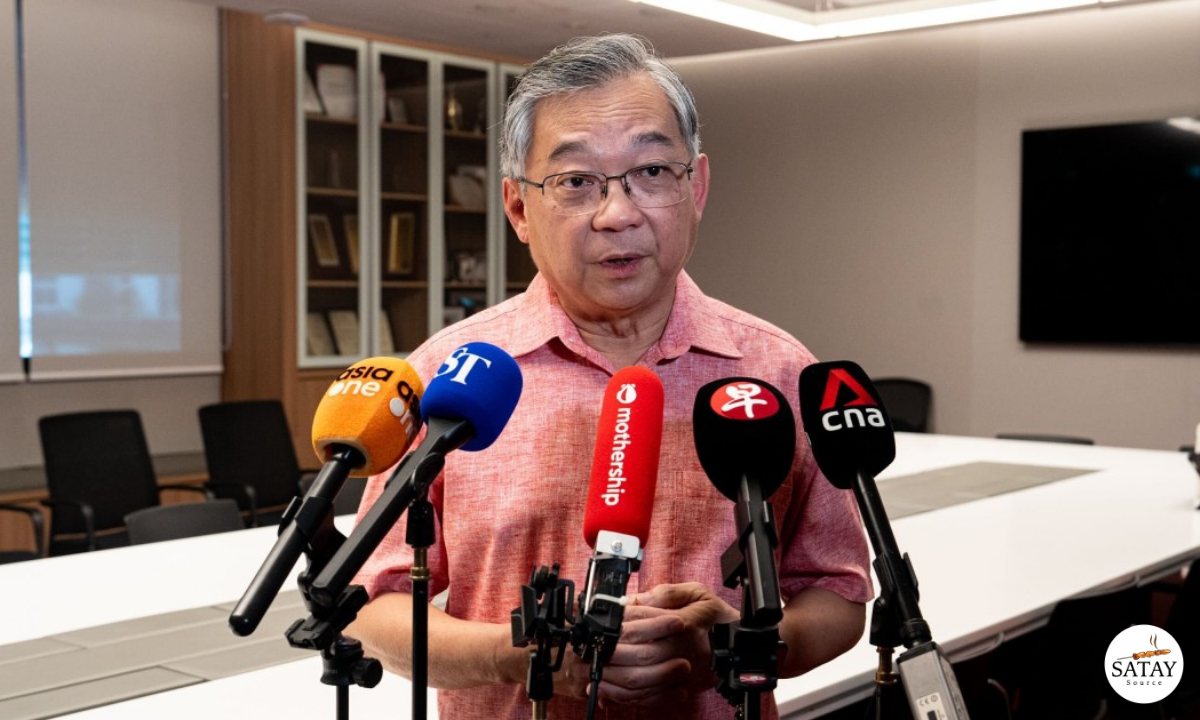


Senior Minister of State for Law and Transport, Murali Pillai, has come forward to defend the People’s Action Party (PAP) government’s approach to managing race relations in Singapore. Speaking on Sunday (Nov 2), Mr Murali said that while the country’s racial policies are “not perfect by any means,” what Singapore has built over the decades is “precious and worth protecting.”
He was responding to a recent social media video by Singapore Democratic Party (SDP) chief Chee Soon Juan, who accused the PAP of dividing society along racial and religious lines.
In his own seven-minute Facebook video, Mr Murali posed a few pointed questions to opposition politicians.
He asked if they believed:
- There should be a minimum number of minority MPs in Parliament.
- Each community group should be able to preserve and strengthen its cultural heritage.
- The HDB heartlands should remain free from racial enclaves.
“If you deny any of this, you discard and reject all that we have achieved over the past decades,” he said.
Murali pointed out that race is never completely absent — whether in politics or in daily life. “We must write this founding principle in our policies and laws, to build a peaceful, stable and harmonious society, one founded on mutual respect and shared progress,” he added.
Past Elections
Recalling his 2016 Bukit Batok by-election against Dr Chee, Mr Murali said he was the first minority candidate the PAP had fielded in a single-member constituency since 2011.
When asked back then if race would be a factor, then-Deputy Prime Minister Tharman Shanmugaratnam had replied, “Race is never absent in politics.”
“It was true in 2016, true today, as it was true in 1965,” Mr Murali said. He also noted that Dr Chee had avoided answering the same question during that election.
Mr Murali referred to Minister K Shanmugam’s recent parliamentary statement on race and religion as a “timely reminder” for all politicians to reject identity politics and protect Singapore’s harmony.
He disagreed with Dr Chee’s claims, saying they “disregard and distort our history.” According to him, PAP’s racial policies are designed to acknowledge differences while safeguarding equality, not to divide.
He cited examples such as the Group Representation Constituencies (GRCs), which ensure minority representation in Parliament, and the reserved elected presidency, which guarantees that all races have a chance at the nation’s top office.
Mr Murali shared his own experiences from elections, saying he had faced “coordinated attempts to politicise the campaign on crude racial lines.” He also recalled that his campaign poster was defaced during GE2020, a “sobering reminder” that race remains part of politics.
“Harmony in Singapore cannot be left to chance or wishful thinking,” he said. “We will not become race-blind simply by removing race from our NRICs or scrubbing out self-help groups.”
He compared Singapore’s situation to other countries: “Europe is dealing with the rise of the far-right, and ethnic divisions in the US have worsened despite Barack Obama’s victory.”
“We cannot strengthen harmony by pretending racial identities don’t exist,” he said. “Our policies — from the GRC system to other safeguards, exist not to divide us, but to protect equality, representation, and harmony.”
He added, “Dr Chee does not understand this. He prefers us to pretend that things will work out on their own.”
Chee Soon Juan’s Response
In his eight-minute video posted on Oct 17, Dr Chee argued that policies like listing race on NRICs only highlight divisions. He also brought up comments made in 2019 by Heng Swee Keat, who said older Singaporeans were not ready for a minority prime minister. “Is this not identity politics at its most repugnant?” Dr Chee asked.
He rejected the rationale for the GRC system, pointing out that leaders such as David Marshall, JB Jeyaretnam, and Tharman Shanmugaratnam had all won major elections without such rules.
Dr Chee ended by calling for a public debate with Mr Shanmugam or any PAP member on “who is really engaging in race identity